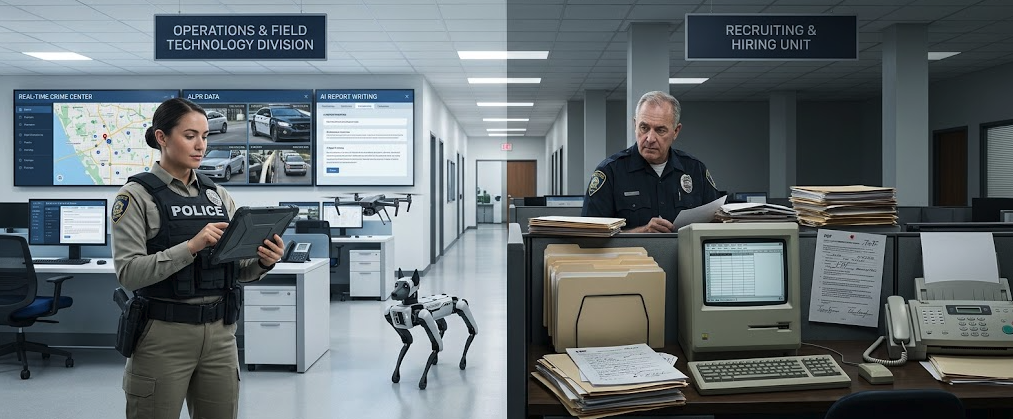
Walk into a modern law enforcement agency and you’ll see technology everywhere. A drone providing overwatch on a search warrant. License plate readers scanning thousands of vehicles an hour. A robotic dog clearing a structure so an officer doesn’t have to. AI drafting an incident report before the officer even gets back to the station.
Now walk into that same agency’s recruiting unit. Too often, you’ll find a PDF application that has to be printed and scanned, a shared inbox nobody fully owns, a spreadsheet of candidates last updated two weeks ago, and applicants waiting months to hear whether they passed a written test.
Law enforcement has embraced sophisticated technology in nearly every operational function—except the one that determines whether there will be officers to operate any of it.
The Operational Side Has Never Been More Advanced
- Drones. Drone-as-first-responder programs put eyes on a scene in seconds, often arriving before patrol units.
- Automated license plate readers. ALPR networks flag stolen vehicles, locate missing persons, and connect crimes across jurisdictions automatically.
- Robotics. Quadruped and tactical robots enter buildings, deliver phones during negotiations, and assess hazardous scenes. More than 60 bomb squads and SWAT teams now deploy robot dogs for standoffs, hostage rescues, and hazmat incidents.
- AI report writing. Artificial intelligence now drafts incident reports from body-worn camera audio, reclaiming much of the time officers historically spent on paperwork.
- Real-time crime centers fuse cameras, gunshot detection, ALPR data, and dispatch records into one operational picture.
Agencies fought for these tools because modern problems demand modern capabilities. So why does that logic stop at the front door of the hiring process?
Meanwhile, in Recruiting
The staffing crisis is not news to anyone wearing a badge. Although hiring has seen a slight rebound, many agencies still haven’t recovered to pre-2020 levels. Every applicant matters. Yet many agencies still run hiring the way they did in 2005:
- Clunky applications that take 45 minutes to complete—an eternity for a candidate who expects a digital-first experience.
- No automated communication, so applicants go months between stages in total silence.
- No centralized tracking, so candidates fall through the cracks between the written test, physical test, backgrounds, and polygraph.
- No analytics, so command staff can’t say where candidates are being lost or which recruiting efforts produce hires.
A candidate’s first real experience with an agency isn’t the ride-along or the academy, it’s the application process. If the operational side says “cutting-edge” but the hiring side says, “county fax machine,” candidates notice.
The Applicants Have Changed—Even If the Process Hasn’t
The candidates agencies need most are the least tolerant of a slow, silent process. Today’s applicants grew up with instant messaging and real-time status updates on everything from a pizza to a rideshare, and they bring those expectations to the job hunt: they expect updates within days, not weeks, read long silences as disrespect—or rejection, and nearly one in five expect an offer within a week of a first interview. For this generation, silence equals rejection: if they don’t hear from you, they assume you’ve moved on—and they do the same.
That’s a hard reality for a profession whose hiring routinely stretches three to twelve months and getting one officer from application to duty can exceed $100,000 and take up to eighteen months. The length is largely non-negotiable. The silence and disorganization within it are not. An agency can’t compress a background investigation into a week. But it can make sure an applicant gets a text the moment they apply, an update when their file moves to backgrounds, and a “you’re still on track” message every couple of weeks in between.
Every week of unexplained silence is a week the best candidate is fielding a call from a neighboring agency or a private-sector employer who made an offer in ten days. The applicants lost to process friction aren’t the marginal ones. They’re the ones with options. Agencies will spend six figures on a robot dog to keep officers safe, and rightfully so. But losing a single qualified candidate mid-pipeline squanders thousands in recruiting spend, testing costs, and background investigator hours, and pushes the vacancy, the overtime, and the burnout further down the road. Agencies that communicate at the speed this generation expects keep the candidates that slower agencies quietly lose.
What “Operational-Grade” Hiring Technology Looks Like
The same principles that justified drones, ALPRs, and AI report writing apply directly to recruiting:
- Automation where humans add no value. Just as AI drafts the routine parts of a report, an applicant tracking system built for public safety automates stage-based communication—confirmations, reminders, status updates—so recruiters focus on relationships, not data entry.
- Real-time situational awareness. A real-time crime center gives commanders a live operational picture. A modern hiring platform does the same for the pipeline: where every candidate stands, which stages create bottlenecks, and who needs attention today.
- Data-driven decisions. Agencies use analytics to deploy resources where they matter. Recruiting analytics show which sources produce candidates who reach the academy—and where the process is bleeding applicants.
- Mobile-first design. Officers expect field tools to work on a phone. So do applicants. A short, mobile-friendly interest form captures a candidate in two minutes; a 40-page PDF loses them in five.
How Respond Capture Fixes the Gap
The agencies winning the recruiting battle aren’t necessarily the ones with the biggest budgets. They’re the ones treating hiring with the same technology standards they apply to operations—because staffing is the foundation every drone program, ALPR network, and real-time crime center is built on. The most advanced technology is worthless without an officer to deploy it.
For agencies flying drones but tracking applicants in a spreadsheet, it’s time to bring the hiring process into the same decade as operations. Respond Capture was built specifically for public safety hiring: multi-stage pipeline management, automated candidate communication, and real-time analytics designed for the realities of law enforcement recruitment.
The next generation of officers is applying somewhere this week. The process they experience should reflect the agency they hope to join.