
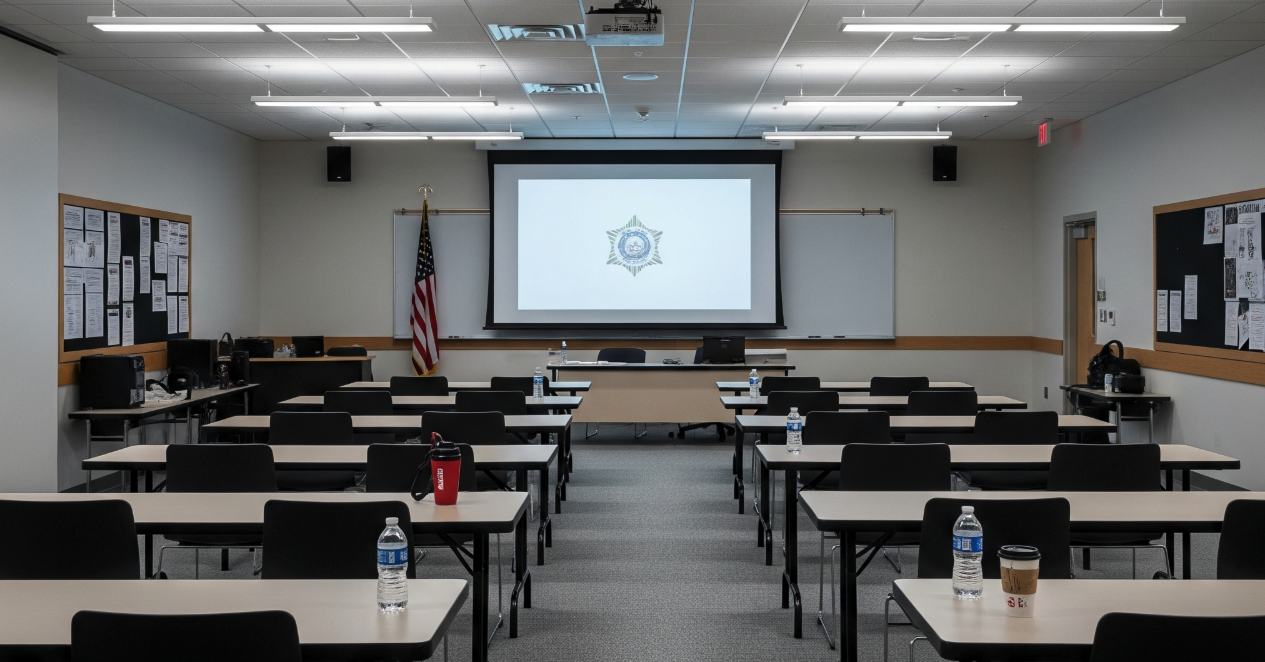
At last week's National Sheriffs' Association Annual Conference in Omaha, we were in the room for a session where a roomful of sheriffs and command staff got one question before the data even started: Is your agency still understaffed? The majority raised their hands. That's the recruiting crisis in a single snapshot — and it's why the way agencies hire has to change.
The seats were full. The coffee was strong. And when a roomful of sheriffs at the Rebuilding the Force session—the R Street Institute's evidence-based session on modernizing recruitment and retention—were asked whether their agencies were fully staffed, the silence answered before the hands did. We were in the room, and a clear majority were still short.
Recruitment and retention ran through the entire Omaha agenda—from agency-wide eLearning that keeps deputies trained without burning overtime, to the retention fallout of promoting leaders before they're ready, to winning over younger candidates. But Rebuilding the Force was the one that went straight at the machinery of hiring: how to modernize and speed up the process, widen candidate pools without lowering standards, and actually land Gen Z and millennial recruits. That's the part too many agencies still get wrong.
These weren't struggling outliers. They were engaged, forward-thinking leaders who showed up to a conference to get better at this. And they're still understaffed. If the agencies doing the work are still behind, the problem isn't effort. It's the system underneath the effort, and that's exactly what the data shows.
The Crisis Isn't a Lack of Interest. It's a Leaky Pipeline.
It's tempting to assume the shortage means nobody wants the job anymore. The data says otherwise. People still want to serve. The problem is that agencies lose them somewhere between "I'm interested" and "I'm sworn in."
Roughly 70 percent of agencies say recruiting is harder than it was a few years ago, and staffing strain ranks among the defining trends researchers are tracking in 2026. But the harder truth is what happens after a candidate raises their hand. Many agencies lose 50 to 70 percent of applicants before they ever reach the background phase—not because those candidates weren't qualified, but because the process let them slip away.
A motivated recruit who applies on Monday and hears nothing by the next week is already filling out applications somewhere else. Private employers move faster, respond quicker, and compete for the same people. Every silent week is a candidate lost, which is why agencies that track applicants from first inquiry forward consistently outperform the ones flying blind.
Speed Is the Whole Game
The single most fixable reason good candidates disappear is time. Hiring timelines that stretch from four months to over a year were built for an era when there was a line out the door. That era is gone. The window in which a candidate stays engaged is measured in days, not quarters.
That doesn't mean cutting corners on backgrounds, polygraphs, or psychological evaluations—those exist for a reason. It means closing the dead air between stages: the unreturned inquiry, the application that sits unread, the three-week gap with no contact. The agencies winning the recruiting battle have shortened their timelines and built communication into every step, so candidates always know where they stand.
Younger Recruits Aren't Lazy. They're Unconvinced.
One of the loudest themes in Omaha—explored in depth in the conference's Beyond the Paycheck session—was the generational shift. The stereotype says younger workers are entitled and won't stay. The research says they're among the most optimistic and purpose-driven people entering the workforce. According to survey findings, the overwhelming majority of both generations rank a sense of purpose as essential to job satisfaction.
They don't want to climb a ladder. They want to join a mission. And here's the part small and rural agencies miss: that's the advantage. In a small community, deputies aren't badge numbers—they're neighbors protecting people they know by name. But if the recruiting message leads with salary ranges and a list of qualifications,it buries the one thing this generation is actually shopping for: the why.
Every Agency Is Offering a Bonus. Which Means No One Is.
Signing bonuses and pay bumps have climbed to levels nobody imagined five years ago—and the vacancy lists keep growing anyway. When every agency in the region offers $20K, the bonus stops being a differentiator. What still moves candidates is everything around the offer: how fast you respond, how your officers talk about the job online, and what your digital presence says about who you are. In 2026, the candidate journey starts on a phone long before it reaches a job fair.
Widen the Pool You're Recruiting From
You can't fix a staffing gap while fishing in half the pond. Women still make up a small share of sworn officers, and the agencies pulling ahead are deliberately recruiting candidates the profession has historically overlooked—an effort organizations like the 30x30 Initiative have put real structure behind. Casting a wider, more intentional net isn't about lowering the bar; it's about making sure qualified people who'd thrive in the job actually see themselves in your message and make it through your process.
Retention Is a Recruiting Strategy
The math is unforgiving: an officer who stays is one fewer vacancy to fill. Agencies that treat retention as a separate HR problem are quietly making their recruiting problem worse. The same things that keep people, such as mentorship, real development, and a culture where they feel seen, are the things that turn current officers into the most credible recruiters. And this applies on the corrections side too, where jails face their own steep staffing climb and the same need to modernize how they attract and keep people.
What This Actually Looks Like in Practice
The agencies pulling ahead aren't doing one heroic thing. They're doing the unglamorous things consistently:
- Responding to every inquiry within 24 to 48 hours, every time
- Keeping candidates informed at each stage so no one goes dark wondering if they were forgotten
- Tracking where applicants drop off—and fixing those specific leak points with data, not guesses
- Leading their message with mission and identity, not a benefits list
- Treating retention and wellness as part of the recruiting strategy, not an afterthought
- Building a digital presence that reflects the agency a recruit actually wants to join
None of this requires lowering standards. It requires refusing to lose good people to a slow, silent, outdated process.
The Hands Don't Have to Stay Up
That room full of raised hands doesn't have to be the future. The shortage isn't proof that nobody wants to serve—the candidates are out there, and they're motivated. The question is whether agencies are built to catch them before someone faster does.
That's the entire reason Respond Capture exists: a recruiting platform built specifically for first responder agencies, carrying candidates from first inquiry through hire and keeping the pipeline visible at every stage, so the people who raise their hands actually make it to day one.