
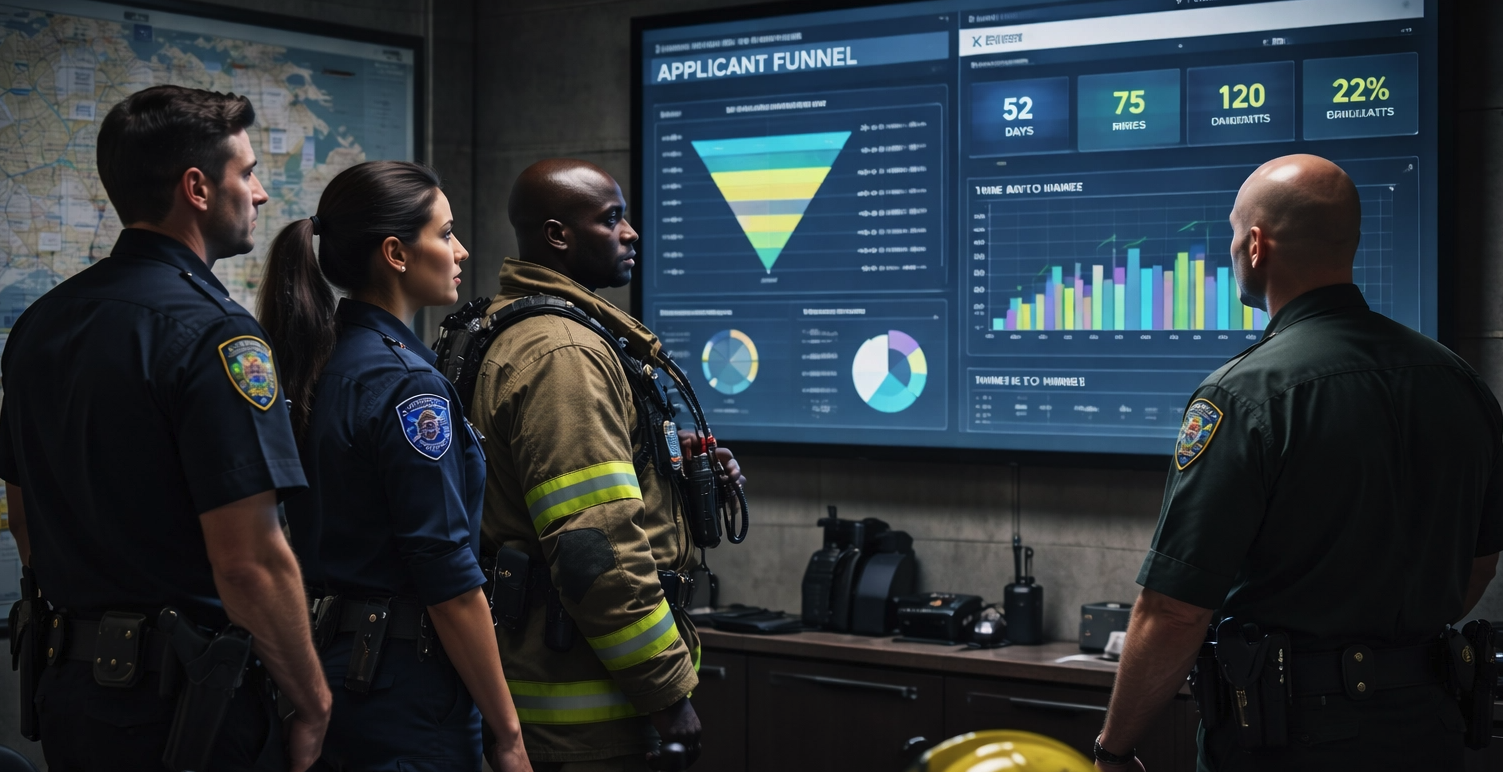
Best Recruiting Metrics Explained in Under 3 Minutes
If you're leading a public safety agency, you've probably heard the phrase "what gets measured gets managed." It's especially true for recruiting. With the ongoing law enforcement staffing crisis, understanding your metrics isn't a nice-to-have—it's survival.
Let's break down the most important recruiting metrics for police, fire, corrections, and EMS agencies.
Why Metrics Matter
Before diving into the numbers, here's the hard truth: most public safety agencies don't track their recruiting performance in any meaningful way. And when you're flying blind, you can't improve.
Metrics give you the ability to:
- Identify bottlenecks in your hiring process
- Justify budget requests with hard data
- Compare performance over time and against benchmarks
- Prioritize resources where they'll have the most impact
Now, let's look at the metrics that matter most.
1. Time to Fill
What it is: The number of days between posting a position and having someone accept an offer.
Why it matters: Long time-to-fill numbers mean you're losing good candidates to faster-moving agencies. In today's market, candidates have options—and they won't wait around.
Benchmark: For law enforcement, the average is often 90–180 days depending on background investigation requirements. If you're significantly above that, start looking for process delays.
2. Time to Hire
What it is: The number of days between a candidate applying and accepting an offer.
Why it matters: This is different from time-to-fill because it focuses on the candidate experience. A long time-to-hire signals process inefficiencies or poor communication.
Pro tip: Track this at each stage (application → screening → interview → background → offer) to pinpoint where candidates are getting stuck.
3. Cost Per Hire
What it is: Total recruiting costs divided by number of hires.
Why it matters: This helps justify your budget and shows leadership where money is being spent. Include advertising, recruiter time, background investigation costs, testing, and onboarding.
Benchmark: Varies widely by agency size and location, but tracking trends over time is more important than hitting a specific number.
4. Quality of Hire
What it is: How well new hires perform and how long they stay.
Why it matters: Getting bodies in seats doesn't help if they wash out of the academy or quit within a year. Track academy completion rates, FTO pass rates, and retention at 1, 3, and 5 years.
What to watch for: If certain recruiting sources consistently produce higher-quality hires, double down on those channels.
5. Offer Acceptance Rate
What it is: Percentage of job offers that get accepted.
Why it matters: If you're making offers but candidates are declining, something is broken—whether it's salary, benefits, reputation, or the offer process itself.
Benchmark: Aim for at least 80%. Below that, survey declined candidates to understand why.
6. Source of Hire
What it is: Where your successful hires came from (job boards, referrals, career fairs, social media, etc.).
Why it matters: Not all recruiting channels perform equally. If most of your hires come from employee referrals but you're spending most of your budget on job boards, you have a misalignment.
Action item: Track source for every applicant, not just hires, to see conversion rates by channel.
7. Applicants Per Opening
What it is: Total number of applicants divided by number of open positions.
Why it matters: This measures your employer brand and the effectiveness of your outreach. More applicants means more options and (usually) better final hires.
Warning sign: If this number is dropping, your marketing and outreach need attention.
Bonus Metric: Retention Rate
While technically not a "recruiting" metric, retention directly impacts recruiting workload. Every officer or firefighter who stays is one fewer position you have to fill.
Track your retention rate alongside recruiting metrics to get the full picture of your workforce pipeline.
How Respond Capture Helps
At Respond Capture, we built our platform specifically to help public safety agencies track these metrics automatically. No more spreadsheets. No more guessing.
Our applicant tracking system captures data at every stage of the recruiting funnel, giving you real-time dashboards and reports that actually mean something.
Ready to start measuring what matters? Learn more about our platform or request a demo today.
The Bottom Line
You can't improve what you don't measure. Start tracking these seven metrics, and you'll quickly see where your recruiting process shines—and where it needs work.
The agencies that win the recruiting battle in the coming years will be the ones who treat data as a strategic asset, not an afterthought.