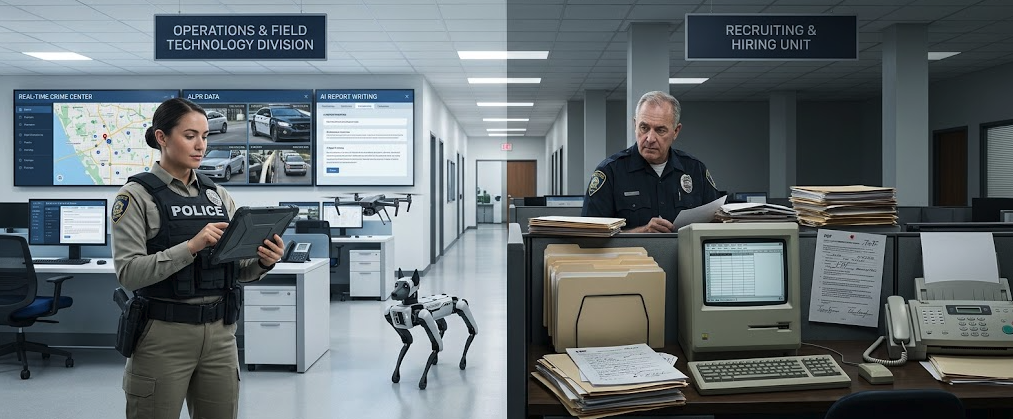
Law enforcement agencies across the United States are facing a historic staffing crisis. Applications have plummeted, resignations have surged, and departments from small towns to major cities are struggling to fill their ranks. While many point to cultural factors and anti-police sentiment as the primary drivers, the research reveals a more complex picture. Generational shifts in workplace expectations, competition from remote-friendly private sector jobs, lengthy hiring processes, mental health challenges, and operational burnout all play significant roles. This report synthesizes the latest data and research to provide a comprehensive view of why people are choosing not to pursue careers in law enforcement, and what the numbers actually show.
The Scale of the Problem
Over 70% of agencies reported that recruitment has become more difficult compared to five years ago. On average, agencies are currently operating at 91% of their authorized staffing levels, indicating a nearly 10% deficit in workforce numbers.¹ Major cities are showing significant shortfalls: San Francisco and Phoenix are short more than 400 officers each, Chicago is short over 1,300, Los Angeles over 1,000, and Philadelphia about 1,200.²
The number of applications for police officer positions has decreased by approximately 40% since 2019.³ Between 2020 and 2021, law enforcement resignation and retirement rates increased by 18% and 45%, respectively.⁴
Primary Reasons People Aren't Joining
1. Negative Public Perception and Anti-Police Sentiment
High-profile incidents and calls for reform have increased scrutiny of police conduct. Many officers report feeling less respected and more concerned for their personal safety. This negative perception makes it harder to attract new recruits, especially those from diverse backgrounds.⁵
Most police chiefs agree: 78 percent of departments identified negative public perception as a significant barrier to recruitment.⁶ The defund the police movement created a shortage of viable candidates to fill remaining police officer positions.⁷
2. Competition from Private Sector and Remote Work
The pandemic created multiple telecommuting opportunities that provided more flexibility, freedom, and, in some cases, money than traditional in-person office jobs.⁸ Millennials and Gen Z candidates, who value work-life balance and flexibility, are less likely to pursue law enforcement careers when private sector jobs offer higher pay and more accommodating schedules.⁵
With the private sector offering more lucrative opportunities and benefits, law enforcement agencies find it challenging to attract candidates. The disparity in compensation and work-life balance between policing and other professions makes it difficult for police departments to compete for talent.⁹
3. Generational Shifts and Values
For many younger Americans, becoming a police officer is no longer an appealing career path.⁸ A 2024 survey found that most college students are not interested in becoming police officers, particularly those with higher grade point averages.⁶
Millennials and Gen Z candidates often prioritize work-life balance and job satisfaction over traditional benefits. As a result, the appeal of long-term careers in law enforcement lessens.¹⁰
4. Demanding Nature of the Job
Top reasons for resignations include: higher pay at another agency, better career growth opportunities elsewhere, dissatisfaction with policing as a career, and work-life balance concerns (long shifts, weekend work, burnout).¹
Officers are leaving law enforcement due to burnout, high-stress work environments, long hours, low morale, public scrutiny, and lack of departmental support. In fact, 53.6% of active officers report experiencing burnout during their careers.¹¹
5. Mental Health and Trauma Exposure
A 2019 study found that 26% of police officers screened positive for a mental health condition, such as burnout, anxiety, depression or PTSD.¹² On average, a law enforcement officer will experience 188 critical events over a career, putting officers at high risk for post-traumatic stress.¹³
Police suicides have steadily risen in recent years. A record was set in 2019 when 238 officers took their lives, more than twice the number of those who died in the line of duty.¹²
6. Lengthy and Rigorous Hiring Process
Many agencies still rely on hiring processes that can take four months to over a year.⁵ On average, a police employment background check takes 6-8 weeks, though law enforcement checks generally take 4-12 weeks due to detailed screening processes.¹⁴
Police departments typically require candidates to undergo a rigorous selection procedure that includes written exams, physical fitness tests, psychological evaluations, and extensive background checks. These stringent requirements can deter many from pursuing a career in policing.⁹
7. Safety Concerns
In 2024, 107 officers died in the line of duty. Sixty-four were killed feloniously, primarily by firearms.¹⁵ Firearms-related fatalities claimed the lives of 52 officers in 2024, representing a 13% increase from 2023 and was the leading cause of death.¹⁶
Over the past five years, an average of 19,975 officers suffer injuries after being assaulted on the job each year.¹⁷
8. Expanded Job Responsibilities
Officers are now expected to handle mental health crises, school security and proactive community policing, as well as their traditional duties. Understaffing increases officer burnout, turnover and response times while limiting crime prevention efforts.²
Diversity Recruitment Challenges
The percentage of officers who are racial or ethnic minorities has increased from 27% in 2019 to 31% in 2024, and the proportion of female officers has risen from 12% to 14% in the same period.³ However, representation still lags significantly behind community demographics.
Recruitment efforts are not specifically directed to communities of color and women. A negative perception of police officers and police departments persists among these groups.¹⁸
Signs of Improvement
Overall confidence in the police rose from 43% in 2023 to 51% in 2024. The eight-percentage-point jump marks the largest annual increase of any of the 17 institutions included in Gallup's yearly update.¹⁹
Black adults' confidence in their local police force is up six percentage points since last year, to 64%, the highest point in four years of measurement.²⁰
References
- IACP. (2024). The State of Recruitment: A Crisis for Law Enforcement. International Association of Chiefs of Police.
- Katz, G. (2025). "Insufficient Police Staffing Continues Throughout the U.S." American Police Beat Magazine.
- Respond Capture. (2024). The State of Police Recruiting in 2024: A Data-Driven Perspective.
- Police Executive Research Forum. (2021). PERF Special Report: Survey on Police Workforce Trends.
- Respond Capture. (2025). The Law Enforcement Recruiting Crisis: What Agencies Need to Know in 2025.
- R Street Institute. (2025). Rebuilding the Force: Solving Policing's Workforce Emergency.
- National Association of School Resource Officers. (2021). "Defunding the Police and the Unintended Consequences."
- Governing. (2024). "Why It's So Hard to Recruit Police Officers."
- CentralSquare. (2024). "Why Police Departments Are Struggling with Recruitment: Challenges and Solutions."
- Domestic Preparedness. (2025). "A Data-Driven Approach to Police Recruitment and Retention."
- SpeakWrite. (2025). Law Enforcement Burnout: A Complete Guide.
- Georgia Public Broadcasting. (2021). "Violence, Stress, Scrutiny Weigh On Police Mental Health."
- Lexipol. (2024). "5 Law Enforcement Policy Trends for 2024."
- Sequenxa. (2024). The Complete Guide to Law Enforcement Background Checks for Employment.
- USAFacts. (2025). "How Many Police Officers Die in the Line of Duty in the US?"
- National Law Enforcement Officers Memorial Fund. (2025). 2024 Law Enforcement Fatalities Report.
- University of Illinois Chicago, Law Enforcement Epidemiology Project. "Law Enforcement Safety."
- U.S. Commission on Civil Rights. "Recruitment, Selection, and Training for Police Work."
- Gallup. (2024). "U.S. Confidence in Institutions Mostly Flat, but Police Up."
- Gallup. (2025). "Racial Divide on Policing Narrows 5 Years After Floyd Death."