
The current police recruiting crisis isn't just a headline. It is a daily reality for departments across the country. You know the story. Applications are down, retirements are up, and the gap between a "Help Wanted" sign and a qualified officer in a squad car is wider than ever. But here is something many agencies realize too late. The problem often isn't just a lack of interest. It is a lack of speed.
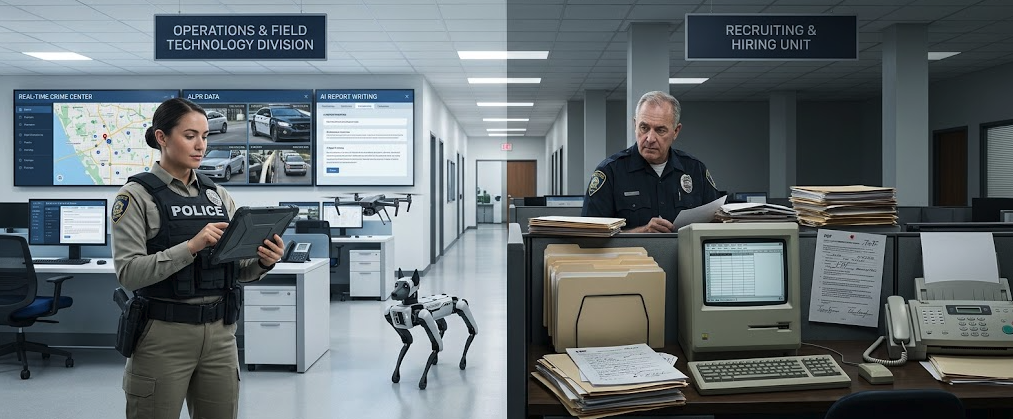
In the private sector, if a candidate applies for a job and doesn't hear back for three days, they have already moved on to the next offer. In public safety, we often expect candidates to wait weeks for a simple confirmation and months for a background check. To survive this environment, your agency needs to stop acting like a government bureaucracy and start acting like a modern recruitment machine. This is where automation moves from being a "nice to have" to a critical operational requirement.
Why Time is Your Agency's Greatest Enemy
The phrase "time kills candidates" is the golden rule of modern recruiting. When a high-quality applicant decides they want to serve their community, they usually apply to four or five different agencies at once. The agency that responds first is the one that sets the tone for the entire relationship.

Many departments suffer from the "recruitment black hole." This happens when an application sits in a generic inbox or a legacy software system for 10 or 14 days before a human even looks at it. By the time your recruiter picks up the phone, that candidate is already halfway through the testing process with a neighboring county.
The police recruiting crisis is effectively a race. If you aren't using automation to bridge the gap between that initial click and the first interview, you are starting the race with your shoes tied together. You can see the impact of these delays yourself by using our recruitment calculator to see how vacancies are actually costing your department in overtime and lost productivity.
The Power of the Automated Drip Campaign
Most recruiters are overworked. They are managing backgrounds, attending job fairs, and trying to keep track of dozens of files at once. It is physically impossible for them to manually follow up with every "maybe" candidate at the frequency required to keep them engaged.
This is where automated SMS and email sequences change the game. The second a candidate hits "submit," they should receive a text message. Not an hour later. Not the next morning. Immediately.
An automated sequence looks something like this:
- Minute 1: A text message thanking them for their interest and providing a link to the next step in the process.
- Day 3: An email containing a video of your specialized units or academy life to keep the "spark" alive.
- Day 7: A check-in text asking if they have any questions about the background packet.
This isn't just about being annoying. It is about being present. Most candidates are applying while they are at their current jobs or sitting on their couch. They are on their phones. If you are relying on mailed letters or even phone calls that go to voicemail, you are losing. Using a digital recruitment strategy means meeting them where they live (on their screens).

Simplicity Matters: The "Drag and Drop" ATS
Recruiters don't want to be data entry clerks. They want to be out in the field finding the next generation of public safety professionals. Unfortunately, many legacy systems are so clunky that they actually add to the recruiter's workload instead of reducing it.
A modern Applicant Tracking System (ATS) should be as easy to use as a social media feed. We talk a lot about "drag and drop" simplicity. This means when a candidate passes their physical agility test, the recruiter literally clicks their profile and drags it to the "Background" column.
When that move happens, the system should automatically trigger the next set of instructions for the candidate. This eliminates the "what do I do next?" emails that clog up a recruiter's morning. By streamlining these recruitment officer tasks, you allow your staff to focus on the high-value work: vetting the character and fitness of the applicants.
Closing the Communication Gap with SMS
If you want to know why your candidate pool is shrinking, look at your open rates. Standard emails in the recruiting world have an open rate of around 20 percent. SMS (text messaging) has an open rate of nearly 98 percent.
In the context of the police recruiting crisis, SMS is your most powerful tool. It allows for "micro-engagements" that keep the candidate moving forward. Did they forget to upload their birth certificate? Send a text with a secure link. Is there a change in the testing location? Send a mass text to everyone in that cohort.
This level of responsiveness builds trust. It shows the candidate that your agency is professional, modern, and genuinely interested in their success. It bridges the gap between the digital world and the seat of a squad car. You can learn more about how this efficiency works in our deep dive on automated ATS benefits.

Reducing the Burden on Overworked Staff
We have to talk about the recruiters themselves. Many are doing the job of three people. When a recruiter is burnt out, their interactions with candidates suffer. They become shorter on the phone. They take longer to respond. They miss the small red flags in a background check because they are rushing to clear the pile on their desk.
Automation is the "force multiplier" for your recruiting unit. By automating the repetitive stuff (reminders, scheduling, document collection), you give your recruiters their time back.
The result is a better experience for everyone:
- Candidates feel supported and informed throughout the 3 to 6 month process.
- Recruiters can spend more time on deep-dive background investigations.
- Command Staff get real-time data on where candidates are dropping out of the funnel.
If you don't address the administrative burden, you will just end up needing to recruit new recruiters. It is a cycle that many agencies are currently trapped in, but it is entirely avoidable with the right tech stack.

Data-Driven Decisions for 2025 and Beyond
One of the biggest issues in public safety hiring is that many agencies don't actually know where their best candidates come from. Did they see a Facebook ad? Did they hear about you at a college fair? Was it a referral from a current officer?
Automation doesn't just send texts. It tracks data. When you use a modern system, you can see exactly which "source" is providing the candidates who actually make it through the academy. This allows you to stop wasting money on job boards that don't work and double down on the strategies that do.
As we look toward the recruiting landscape of 2025, data will be the differentiator between agencies that stay staffed and those that have to cut services. You cannot manage what you do not measure.

Moving Forward: The Path to a Full Roster
The police recruiting crisis is a complex problem with no single solution. However, fixing the "communication gap" is the lowest hanging fruit available to any agency. You don't need a million-dollar budget to start responding to candidates faster. You just need better systems.
By implementing automated sequences and a simplified ATS, you aren't just buying software. You are buying speed. You are buying recruiter sanity. Most importantly, you are buying the ability to land the best candidates before your competition even knows they applied.
The gap between a lead and a hire is where most agencies fail. If you can bridge that gap with automation, you will find that the "shortage" of candidates isn't always a lack of people. Often, it is just a lack of a clear, fast path into the uniform.
If you are ready to see how your agency can speed up its time-to-hire, check out our services page or contact us to start a conversation. The future of your department depends on how fast you can move today.