
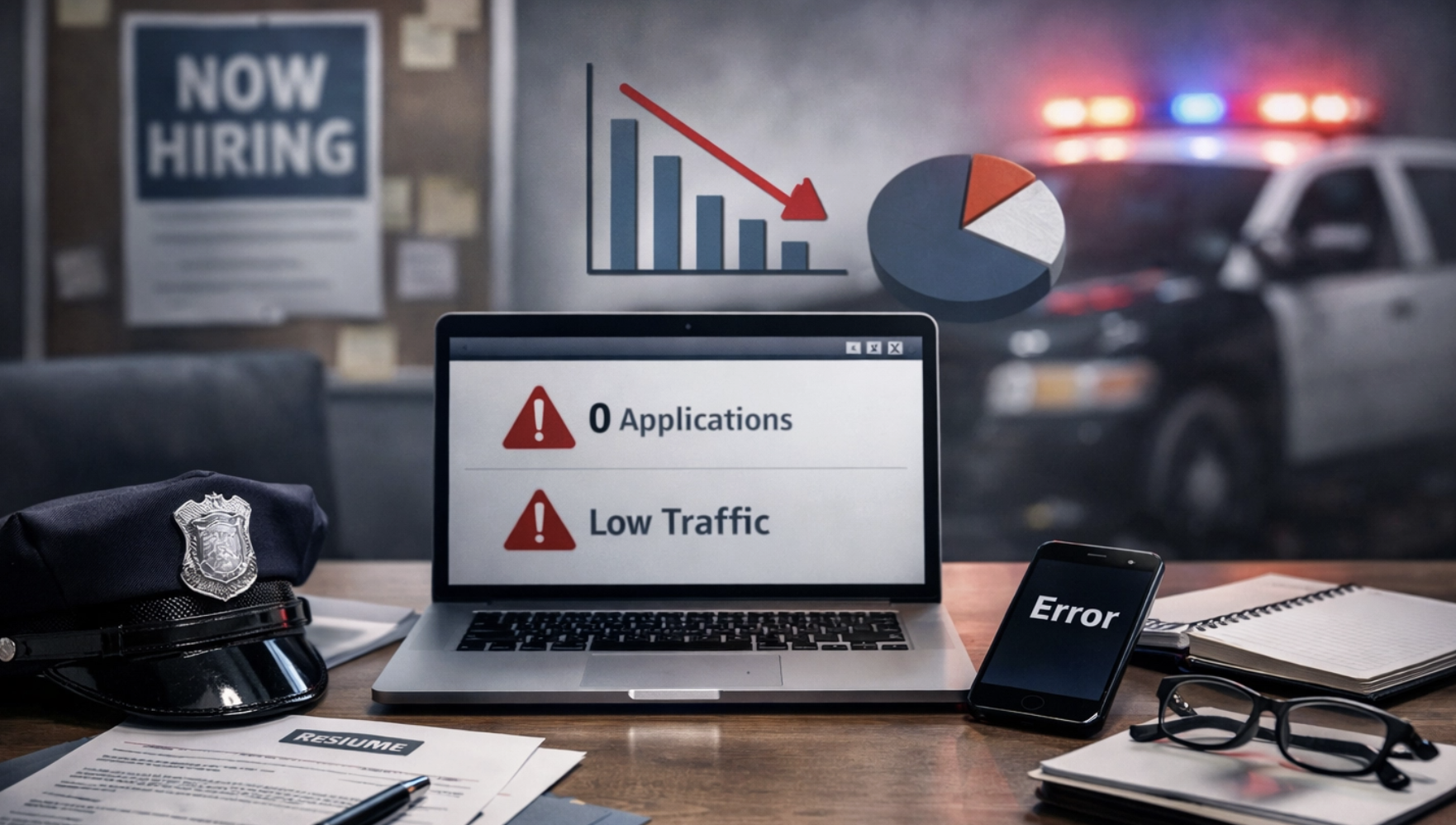
Law enforcement recruitment issues have reached crisis levels, with 65% of agencies reporting too few candidates applying for officer positions. And while factors like public perception and lengthy hiring processes play a role, there's a silent killer in your recruitment pipeline that's costing you qualified candidates every single day. Your website is a broken front door, and candidates are walking away before they ever knock.
The Broader Recruitment Crisis (And Why Your Website Makes It Worse)
Let's be clear about the landscape. 75% of agencies report that recruiting is more difficult today than it was five years ago. The reasons are well-documented: shifting public perception, generational attitudes toward law enforcement careers, and increasingly competitive labor markets.
But here's the part that gets overlooked. While you can't control national headlines or generational trends, you absolutely can control how candidates experience your agency when they search for opportunities. And right now, that experience is driving them straight to your competitors.
47.5% of agencies have hiring processes that last four months to over a year. That's already a massive hurdle. When you combine that timeline with a website that loads slowly, looks outdated, or functions poorly on mobile devices, you're not just losing passive browsers. You're losing serious candidates who interpret your digital presence as a signal of how the entire hiring process will go.
How Your Website Is Actively Undermining Recruitment
Most law enforcement websites weren't built with recruitment in mind. They were built for community information, press releases, and internal resources. The career section was an afterthought, and it shows. Here's how these issues manifest.
Poor Visibility and Outdated Content
When was the last time someone from your agency updated the careers page? If the answer involves scrolling back through your mental calendar, you've already identified the problem.
Search engines prioritize fresh, relevant content. When your website contains job postings from six months ago, announcements dated last year, or FAQs that reference outdated policies, Google interprets that as a signal that your site isn't worth showing to searchers. Candidates searching for "police officer jobs [your city]" aren't finding you because your content signals institutional inactivity.
This isn't just a visibility issue. It's a credibility issue. A candidate who does stumble onto your site sees outdated content and makes an instant judgment: this agency doesn't have its act together.
Mobile Optimization Failures
Over 60% of job searches now happen on mobile devices. Your website was probably designed in 2015 for desktop viewing. See the problem?
When a candidate pulls up your careers page on their phone and has to pinch, zoom, and scroll sideways just to read the job description, they're gone. They're not going to wrestle with your site. They're going to apply to the agency whose mobile experience actually works.

Fast-loading, mobile-optimized sites don't just improve user experience. They directly impact search rankings. Google prioritizes sites that load quickly and function properly on mobile devices. If your site takes eight seconds to load or requires horizontal scrolling on a smartphone, you're invisible to the candidates you need most.
Lack of Transparency and Communication
Qualified candidates want to know what they're getting into. They have questions: What does the hiring process look like? How long does a background check take? What are the physical fitness requirements? What happens after I submit my application?
Most law enforcement websites answer exactly none of these questions. Or worse, they bury the answers three clicks deep in a PDF that was last updated in 2019.
This absence of transparency compounds the already lengthy hiring timelines. Candidates who don't know what to expect drop out early. They accept other offers. They lose interest. The agencies that provide clear, upfront communication about requirements and timelines maintain significantly higher candidate engagement throughout the process.
Disconnected Recruitment Strategy
Here's a scenario that plays out constantly. Your agency posts jobs on Indeed, LinkedIn, and Glassdoor. Candidates click the link and land on... a generic third-party application form. Or they're redirected to your main homepage with no clear path to the actual application.
This fragmented approach prevents you from controlling your narrative. You've lost the opportunity to showcase your agency's culture, benefits, and mission. Worse, you've created friction in the application process. Every additional click, every confusing redirect, every moment of "wait, where do I actually apply?" costs you candidates.
What Good Looks Like
The good news: agencies that fix these issues see measurable improvements in application volume and quality. Here's what effective digital recruitment infrastructure includes.

Custom recruitment landing pages built specifically for each campaign or position. These pages are designed with a single goal: convert interest into applications. They load fast, work flawlessly on mobile, and guide candidates through a clear path from curiosity to submission.
Transparent communication throughout the candidate journey. Effective recruitment pages include detailed FAQs, realistic timelines, clear qualification requirements, and honest information about what candidates can expect at each stage.
Conversion-optimized design that removes friction. Simple application forms. Minimal required fields upfront. Clear calls to action. Mobile-first design that works seamlessly across devices.
Fresh, relevant content that signals organizational health and activity. Regular updates to job postings, recent success stories from new hires, and current information about academy schedules and training programs.
The Respond Capture Approach
This is where purpose-built recruitment infrastructure makes the difference. Respond Capture creates custom landing pages and conversion tools designed specifically for public safety recruitment. These aren't generic job boards or retrofitted corporate hiring platforms. They're built from the ground up to address the unique challenges law enforcement agencies face.
The system works like this. When you launch a recruitment campaign (whether it's on social media, Indeed, or through targeted ads), candidates land on a dedicated page built specifically for that position or campaign. That page loads in under two seconds on any device. It provides clear information about the role, requirements, and hiring process. And it includes a streamlined application form that captures qualified candidates without creating unnecessary barriers.
Behind the scenes, the platform tracks every interaction. You see exactly where candidates are coming from, which messages are resonating, and where drop-off is happening. That data allows you to refine your approach in real time, focusing resources on what actually works.
Moving Forward: Action Steps
If you're reading this and recognizing your agency's website in these descriptions, here's where to start.
Audit your current careers page. Pull it up on your phone right now. How long does it take to load? Can you easily find the application? Is the information current? Would you apply based on what you see?
Identify your biggest friction points. Is it outdated content? Mobile functionality? Lack of clarity about the hiring process? Start with the issue that's easiest to fix and build momentum from there.
Consider purpose-built recruitment infrastructure. If your current website wasn't designed for recruitment (and it probably wasn't), explore solutions specifically built for this purpose. Generic improvements to your main site might help, but dedicated recruitment landing pages deliver measurably better results.
Prioritize speed and mobile experience. These aren't nice-to-haves. They're fundamental requirements for modern recruitment. If your site doesn't work seamlessly on mobile devices, you're invisible to most candidates.
The law enforcement recruitment crisis is real, and it's not going away. But the agencies that are succeeding aren't just posting jobs and hoping for the best. They're building recruitment infrastructure that meets candidates where they are, removes unnecessary barriers, and creates clear paths from interest to application.
Your website is either helping you compete for top talent or actively undermining that effort. There's no middle ground. The question is: which side are you on?
Ready to see what conversion-optimized recruitment infrastructure looks like for your agency? Explore Respond Capture's approach or check out the recruiting calculator to understand exactly how many applicants you need to hit your hiring goals.